
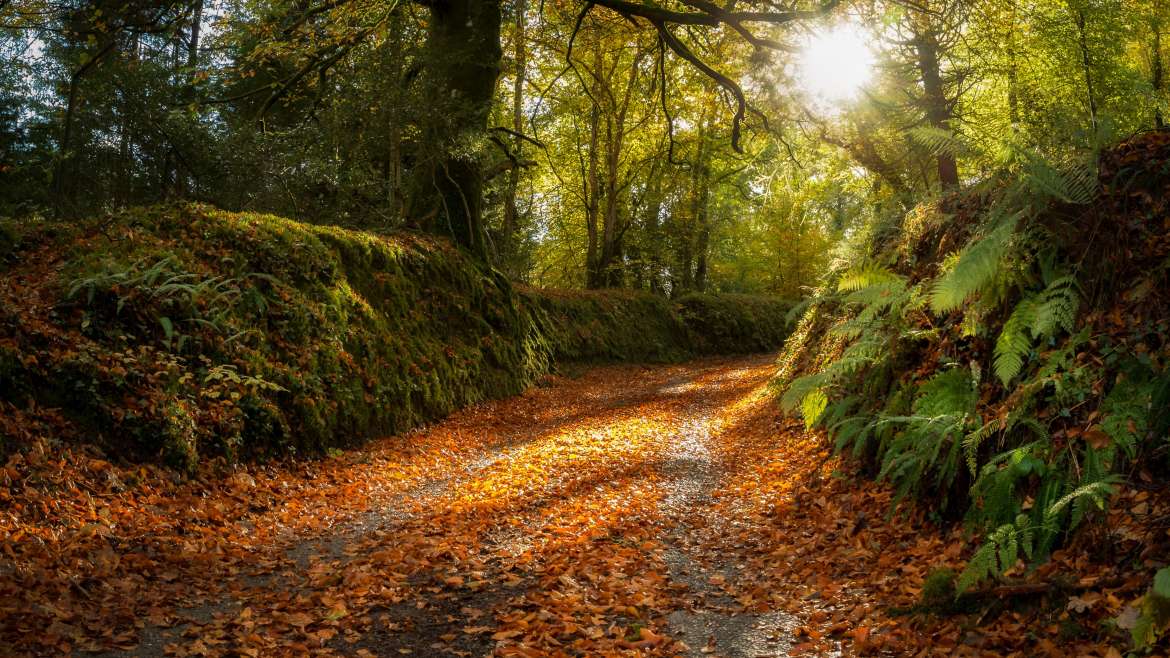
Autumn brings rain, wet roads, fallen leaves, low sunlight and darker evenings. Learn how to adapt your driving, improve visibility, manage stopping distances and stay safe on UK roads.
Rain, low sun, fallen leaves and darker evenings all require you to adapt your driving
Autumn can be one of the most enjoyable times of year to drive in the UK. The roads can look fantastic, the countryside changes colour and there is something satisfying about heading out on a crisp autumn morning.
But autumn also brings a noticeable change in driving conditions. Rain becomes more frequent, the temperature drops, roads can become slippery, the sun sits lower in the sky and daylight disappears earlier. Windscreens mist up more easily, while fallen leaves can cover road markings and hide hazards.
None of these things necessarily make driving dangerous.
What makes autumn driving dangerous is failing to recognise that the conditions have changed.
The good news is that you don’t need a completely different set of driving skills. You simply need to adapt the skills you already have.
Autumn driving is about adapting
One of the most important principles in The Highway Code is found in Rule 146, which advises drivers to adapt their driving to the appropriate type and condition of road they are on.
The Code specifically warns that speed limits should not be treated as targets and that drivers should take road and traffic conditions into account.
That principle becomes particularly important during autumn.
A road that was perfectly comfortable at 50 or 60 mph on a dry summer afternoon might require a different approach when it is wet, covered with leaves, poorly lit, affected by low sunlight, obscured by spray or made more difficult to see along because of mist or rain.
The road hasn’t necessarily become dangerous.
The circumstances have changed.
Your driving should change with them.
1. Expect longer stopping distances in the wet
Rain is probably the most obvious autumn driving hazard.
But the biggest mistake is thinking:
“It’s only a bit of rain.”
The Highway Code’s Rule 227 states that in wet weather, stopping distances will be at least double those required on dry roads because tyres have less grip on the road.
That doesn’t mean you should automatically drive at half your normal speed whenever it rains.
It means you need to think further ahead and give yourself more space.
The Highway Code recommends at least a two-second gap in normal circumstances on higher-speed roads and says that the gap should be at least doubled on wet roads.
So if you normally use a two-second gap, think in terms of at least four seconds in wet conditions.
And remember that “at least” matters.
If visibility is poor, the road is particularly slippery or spray is making it difficult to see, you may need considerably more.
A simple technique
Instead of simply looking at the vehicle immediately ahead, constantly ask yourself:
“If that vehicle braked now, would I have enough room to stop comfortably?”
If the answer is no, you’re too close.
2. Don’t just slow down — create space
A common reaction to bad weather is simply to reduce speed.
That can help, but speed isn’t the only thing that matters.
Space is one of your greatest safety margins.
Imagine you are travelling at an appropriate speed but following another vehicle closely.
If that vehicle suddenly brakes, you have very little time to react.
Now imagine exactly the same situation but with a much larger gap.
You have more time to:
- recognise what is happening
- decide what to do
- brake progressively
- change your position if necessary
- deal with something else happening around you
This is particularly important in autumn because wet roads, spray and poor visibility can all reduce the time available to react.
Don’t simply drive slower. Give yourself more room.
3. Standing water: don’t underestimate it
Heavy autumn rain can leave standing water in dips, at the side of roads and underneath bridges.
It can be tempting to simply drive through it.
But standing water can cause your tyres to lose contact with the road surface — a phenomenon commonly known as aquaplaning.
The best technique is prevention.
Look ahead for large puddles, water running across the road, dips in the road, areas where water tends to collect and vehicles ahead throwing up large amounts of spray.
If you can safely avoid standing water, do so.
If you cannot, reduce your speed before reaching it rather than braking or making sudden steering inputs while you’re in it.
And remember that water can conceal potholes or other defects.
4. Don’t brake hard or steer sharply through standing water
If you hit standing water unexpectedly, the most important thing is to remain calm.
Avoid sudden braking, acceleration or steering movements.
Keep the steering steady and allow the vehicle to travel through the water.
If you feel the steering become unusually light, this may indicate that the tyres have temporarily lost some contact with the road.
Avoid the temptation to make a dramatic steering correction.
As the tyres regain contact with the road, normal steering control should return.
The best technique is therefore smoothness and anticipation.
5. Fallen leaves can make the road slippery
Fallen leaves are one of the more underestimated autumn hazards.
A layer of wet leaves can provide surprisingly little grip, particularly on bends, downhill sections, junction approaches, braking areas, cycle lanes and shaded sections of road.
They can also hide potholes, road markings, drains, kerbs and debris.
You don’t necessarily need to crawl along whenever you see leaves.
Instead, ask yourself:
“What would happen if I needed to brake or change direction here?”
If the answer makes you uncomfortable, reduce your speed before reaching the affected area.
6. Be particularly careful on bends
Autumn is a good time to improve your approach to bends.
The Highway Code’s guidance on speed is based around being able to stop within the distance you can see to be clear and adapting your speed to the road and circumstances.
So rather than thinking:
“It’s a 50 mph road, so I can do 50.”
Think:
“What speed allows me to deal safely with what I can see?”
That might be 50 mph.
It might be 40.
It might be considerably less.
The important thing is that your speed is appropriate before you reach the hazard.
7. Low autumn sun can be more dangerous than rain
Rain gets most of the attention, but low autumn sunshine can be just as problematic.
As the sun gets lower in the sky, you may find yourself driving directly towards it.
This can make traffic lights difficult to see, brake lights harder to distinguish, pedestrians difficult to spot, road markings less obvious and cyclists and motorcyclists harder to see.
The Highway Code’s Rule 93 advises drivers to slow down, and if necessary stop, if they are dazzled by bright sunlight.
That’s important.
Being dazzled isn’t simply an inconvenience. It is a reduction in your ability to see hazards.
If you cannot see properly, your speed needs to reflect that.
8. Keep your windscreen clean
A dirty windscreen can make low sunlight dramatically worse.
The combination of dirt, grease, moisture and low sunlight can create a huge amount of glare.
You may find that a windscreen that looked perfectly clean during normal daylight suddenly appears covered in reflections when the sun is low.
Make sure the inside of the windscreen is clean, the outside is clean, washer fluid is topped up and wipers are working properly.
The Highway Code’s vehicle-maintenance guidance specifically says that windscreens and windows must be kept clean and free from obstructions to vision, while lights, indicators, reflectors and number plates must also be kept clean and clear.
9. Use your sun visor — but don’t rely on it
Your sun visor can help when the sun is low.
But if the sun is directly in front of you and the visor doesn’t solve the problem, reduce your speed.
Don’t allow yourself to fall into the trap of thinking:
“I can’t see very well, but I’ll carry on because everyone else is doing the same speed.”
If visibility is compromised, your driving needs to compensate.
You might need to slow down, increase your following distance, avoid overtaking, delay a manoeuvre or stop if necessary.
There is no shame in slowing down because you can’t see.
That’s good driving.
10. Expect darker roads earlier
One of the biggest changes during autumn is how quickly daylight disappears.
A journey that was completed in bright daylight a few weeks earlier may now finish in darkness.
This has several consequences.
You may encounter pedestrians who are harder to see, cyclists with lights, glare from headlights, unlit roads, poorly visible junctions and more difficulty judging distance.
Wet roads can also reflect headlights and street lighting, creating additional glare.
The Highway Code states that night — legally defined for lighting purposes — is the period from half an hour after sunset until half an hour before sunrise.
Drivers must use headlights at night except on roads with lit street lighting, and must use headlights when visibility is seriously reduced.
But don’t wait until it feels completely dark before thinking about visibility.
Autumn often creates a gradual transition from daylight to poor visibility.
Adjust accordingly.
11. Understand the difference between darkness and seriously reduced visibility
These are not the same thing.
You can have darkness where it’s night-time but visibility is otherwise good.
Poor visibility is different. Rain, fog, spray or other conditions can significantly reduce how far you can see.
The Highway Code’s Rule 226 says headlights must be used when visibility is seriously reduced, generally when you cannot see for more than 100 metres.
Fog lights have specific restrictions too.
Front and rear fog lights should only be used when visibility is seriously reduced and must be switched off when visibility improves, so they don’t dazzle other road users.
Don’t use fog lights simply because it is raining or dark.
12. Watch for pedestrians in darker clothing
Autumn changes the way people dress.
Bright summer clothing disappears.
Dark coats, hats and umbrellas can make pedestrians much harder to see, particularly near schools, in residential areas, at bus stops, near shops and around pedestrian crossings.
Don’t assume that because you haven’t seen someone, nobody is there.
Look particularly carefully when approaching areas where pedestrians are likely.
And remember that pedestrians may also have reduced visibility because they’re dealing with rain, umbrellas and darkness.
13. Give cyclists more consideration
Autumn conditions can be particularly unpleasant for cyclists.
Rain, wind, wet leaves and reduced daylight can all affect their ability to maintain a steady position.
A cyclist may also move around potholes, puddles, drains, leaves or parked vehicles.
Don’t interpret a cyclist changing position as necessarily being unpredictable or inconsiderate.
They may simply be avoiding a hazard.
Give them the space and time they need.
The Highway Code’s hierarchy of road users and Rule H3 place particular emphasis on drivers taking care around cyclists, motorcyclists, horse riders and other vulnerable road users when changing direction or position.
Remember that your car gives you considerably more protection than a bicycle does.
That difference should influence the way you drive around vulnerable road users.
14. Expect more spray from other vehicles
On faster roads, spray can become a significant visibility problem.
Large vehicles can throw enormous amounts of water into the air.
If you’re following one, you may suddenly find that your view of the road ahead is dramatically reduced.
The answer isn’t necessarily to overtake immediately.
Sometimes the safest option is simply to increase the gap.
This allows the spray to disperse and gives you a clearer view.
If you do overtake, make sure the manoeuvre is genuinely safe and that you have sufficient visibility.
Remember:
If you can’t see, you can’t properly assess the road ahead.
15. Don’t follow too closely in autumn
Tailgating becomes particularly dangerous in wet conditions.
If the vehicle ahead suddenly brakes, your stopping distance is longer than it would be on a dry road.
Add rain, spray, poor visibility, leaves and darkness and the margin becomes even smaller.
The DVSA’s current examiner guidance specifically recognises that wet or slippery roads increase stopping distances and expects candidates to maintain a safe separation distance.
This applies whether you’re learning or have been driving for 30 years.
Following distance is one of the easiest safety improvements you can make.
16. Be prepared for misted windows
As the temperature drops, condensation becomes increasingly common.
It can happen particularly when several people are in the car, clothing is wet, the outside temperature is low, the car has been parked overnight or the heater hasn’t been used properly.
Don’t start driving with partially misted windows.
Take the time to clear them properly.
Your ability to see is one of the most important parts of safe driving.
If your car has a heated windscreen or automatic demisting function, learn how to use it before you need it.
17. Don’t drive with steamed-up windows
It sounds obvious, but it is surprisingly easy to become impatient on a cold morning.
You start the car.
The windscreen is misted.
You can see just enough to leave.
So you drive.
That is not a good habit.
Wait until your view is clear.
The Highway Code requires drivers to ensure their windscreen and windows are clean and free from obstructions to vision.
A two-minute wait is insignificant compared with the consequences of driving without a proper view.
18. Check your tyres before autumn really arrives
Your tyres are your only contact with the road.
That makes autumn a good time to check tread depth, tyre pressures, damage, cuts, bulges and uneven wear.
Don’t only check the tyres you can see easily.
Check all four.
And remember that the legal minimum tread depth isn’t necessarily the point at which a tyre is performing at its best.
If you regularly drive on wet roads, having tyres in good condition is particularly important.
19. Check your lights
Autumn means more driving in darkness.
It also means more situations where being visible to other road users matters.
Check your headlights, brake lights, indicators, rear lights, fog lights and number plate lights.
And keep them clean.
Mud, road grime and spray can quickly reduce the effectiveness of lights.
The Highway Code’s vehicle-maintenance guidance specifically requires lights, indicators, reflectors and number plates to be kept clean and clear.
20. Don’t forget your mirrors
Autumn driving can produce more condensation and spray.
That means your mirrors may become dirty or obscured much more quickly.
Before setting off, make sure your mirrors are correctly adjusted, clean and free from condensation.
And continue checking them regularly while driving.
Good observation becomes even more important when conditions make other road users harder to see.
21. Adapt your cornering technique
Wet roads don’t mean you have to drive around every bend at walking pace.
But they do mean you should think carefully about where you brake and accelerate.
A useful technique is to slow before the bend, choosing an appropriate speed while you still have good visibility and grip.
Steer smoothly and look where you want to go rather than staring at the hazard you are trying to avoid.
As the road opens up and you can see that it is safe, accelerate progressively and return to your desired speed.
This technique isn’t exclusive to autumn.
But slippery roads make the benefits of smooth driving much more obvious.
22. Be especially careful on rural roads
This is particularly relevant in the Chilterns.
Autumn can make rural roads considerably more challenging.
You may encounter fallen leaves, mud, standing water, tractors, agricultural machinery, cyclists, horse riders, deer, fallen branches, poorly lit roads and changing road surfaces.
The road may look exactly the same as it did in summer.
But the hazards have changed.
A road that you know well should never be treated as completely predictable.
Familiarity is useful. Complacency isn’t.
23. Watch for mud on the road
Autumn is harvest season.
That means agricultural vehicles can leave mud on roads.
Mud can significantly reduce grip and may be particularly hazardous when wet.
If you see mud ahead, reduce speed, avoid sudden steering, leave extra space and expect the surface to be slippery.
Don’t assume that because the road is normally dry and grippy, it will remain that way.
24. Be aware of animals
Autumn can also bring increased wildlife activity.
Deer are a particular consideration on rural roads.
If you see one deer, don’t immediately assume the road is clear after it has crossed.
There may be others following.
The sensible response is to reduce speed and increase your observation.
The same principle applies to horses, livestock, dogs and wildlife generally.
If you can’t predict what an animal is going to do, give yourself time and space to react.
25. Don’t let familiarity make you complacent
This is perhaps one of the biggest risks for experienced drivers.
You know the road.
You’ve driven it hundreds of times.
You know the bends.
You know the junctions.
You know where the speed limit changes.
But you don’t know what is around the next bend today.
You don’t know whether there is water on the road, whether a cyclist is around the corner, whether a tree has dropped branches, whether a vehicle has broken down or whether the road surface has changed.
The Highway Code’s Rule 146 is effectively a reminder that the road doesn’t have to change for the appropriate driving speed to change.
The conditions are enough.
Autumn driving and the UK practical driving test
If you’re preparing for your practical driving test, autumn can actually be a very useful time to practise.
The DVSA expects candidates to demonstrate that they can drive safely in different road and traffic conditions.
That doesn’t mean you need to demonstrate a special “autumn driving routine”.
Instead, the examiner is looking for the same fundamental skills: appropriate speed, effective observation, appropriate following distance, good anticipation, smooth control, appropriate responses to hazards and safe progress.
The DVSA’s examiner guidance states that safe and reasonable progress should take account of road, traffic and weather conditions, as well as signs and speed limits.
So if it is raining heavily during your test, don’t feel that you have to maintain the same speed you might use on a dry day.
Equally, don’t become so cautious that you unnecessarily hold up other traffic.
The examiner is looking for appropriate driving for the conditions.
What if it rains during your driving test?
Don’t panic.
Rain itself does not mean that your driving test will be cancelled.
Driving tests can take place in ordinary wet weather.
Tests are cancelled when weather conditions become dangerous, such as flooding, ice, thick fog or high winds.
So if you arrive for your test and it’s raining:
Treat it as another driving condition to manage.
Increase your following distance.
Adjust your speed.
Use your controls smoothly.
Make sure you can see.
Look further ahead.
Anticipate hazards.
That’s exactly what competent driving should look like.
Don’t become excessively cautious
This is an important point for learner drivers.
When conditions deteriorate, some learners make the opposite mistake.
They become so concerned about being safe that they stop making normal progress.
For example, they might drive far below an appropriate speed, wait unnecessarily at junctions, hesitate when there is clearly enough time, refuse to overtake when it is safe, slow dramatically for every puddle or become fixated on the weather rather than the road.
The DVSA specifically assesses progress and expects candidates to drive at an appropriate speed for the road and traffic conditions.
Driving unnecessarily slowly and holding up traffic can result in faults.
The answer isn’t to become timid.
It’s to become better at judging conditions.
The three-second question
Throughout autumn, regularly ask yourself:
“If something happened right now, would I have enough time and space to deal with it?”
If the answer is yes, you’re probably giving yourself a reasonable safety margin.
If the answer is no, change something.
Perhaps slow down, increase your following distance, improve your visibility, change your position, delay an overtaking manoeuvre or wait before emerging.
Good driving is often about creating time and space.
A simple autumn driving routine
Before setting off on an autumn journey, take a few seconds to consider the conditions around you.
Can you see clearly through the windscreen and mirrors? Is it raining, foggy, windy or otherwise affecting visibility? Is the road wet, covered in leaves, muddy or affected by standing water? Is the low sun affecting your vision, and will the journey take you into darkness?
Then think about the car itself. Are the tyres, lights, wipers and washers working properly? Have you increased your following distance enough for the conditions? And, most importantly, is your speed appropriate for what you can actually see and anticipate?
That takes very little time.
But it can make a significant difference.
Autumn doesn’t mean you have to stop enjoying driving
There is an important balance here.
Autumn driving shouldn’t be about being frightened of every wet road or every leaf.
It should be about understanding how the conditions affect your car and adjusting accordingly.
A wet road can still be enjoyable.
A crisp morning drive can be fantastic.
A winding rural road can still be rewarding.
The difference is that a good driver recognises when the conditions require a different approach.
Enjoy the road, but respect what the road is telling you.
The most important autumn driving skill: anticipation
If there is one skill that makes autumn driving easier, it is anticipation.
Look further ahead.
Notice changing conditions.
Ask yourself what might happen next.
If you see dark patches of water, think about grip.
If you see leaves covering a bend, think about the road surface.
If the sun is low, think about visibility.
If the sky is getting darker, think about your lights.
If traffic is slowing ahead, think about your stopping distance.
If you see a cyclist ahead, think about how the weather might affect their position.
You are constantly trying to stay one step ahead of the road.
That’s what good driving is about in any season.
Autumn driving: slow down when you need to, not because you are scared
There is a useful distinction between caution and fear.
Caution says:
“The road is wet, so I’ll increase my following distance.”
Fear says:
“The road is wet, so I don’t feel comfortable driving.”
Caution says:
“The sun is dazzling me, so I’ll slow down.”
Fear says:
“I can’t see properly but I’ll just keep going.”
Caution is informed by observation.
Fear often leads to unpredictable decisions.
Your aim should be to understand the conditions well enough to make sensible adjustments.
The bottom line
Autumn doesn’t require you to become a different driver.
It requires you to become a more observant driver.
Rain means less grip and longer stopping distances.
Leaves can reduce grip and hide hazards.
Standing water can cause loss of control.
Low sun can seriously affect visibility.
Shorter days mean more driving in darkness.
Cold mornings mean more condensation.
Mud and agricultural activity can change the road surface.
Wildlife and vulnerable road users can be harder to see.
None of these should come as a surprise.
They are simply part of driving in the UK.
The Highway Code’s advice is consistent throughout:
Adapt your driving to the conditions.
Don’t treat the speed limit as a target.
Leave yourself enough time and space to react.
Make sure you can see.
Keep your vehicle in good condition.
And anticipate what might happen next.
For learner drivers, these are exactly the skills that will help you become a safer and more confident driver.
For experienced drivers, autumn is a useful reminder that being familiar with a road doesn’t mean the conditions are familiar.
The road may be the same.
Your approach shouldn’t always be.
Drive for the conditions you actually have — not the conditions you wish you had.
For more advice on adapting to weather and road surfaces, explore my guide to safe driving in wet conditions.