
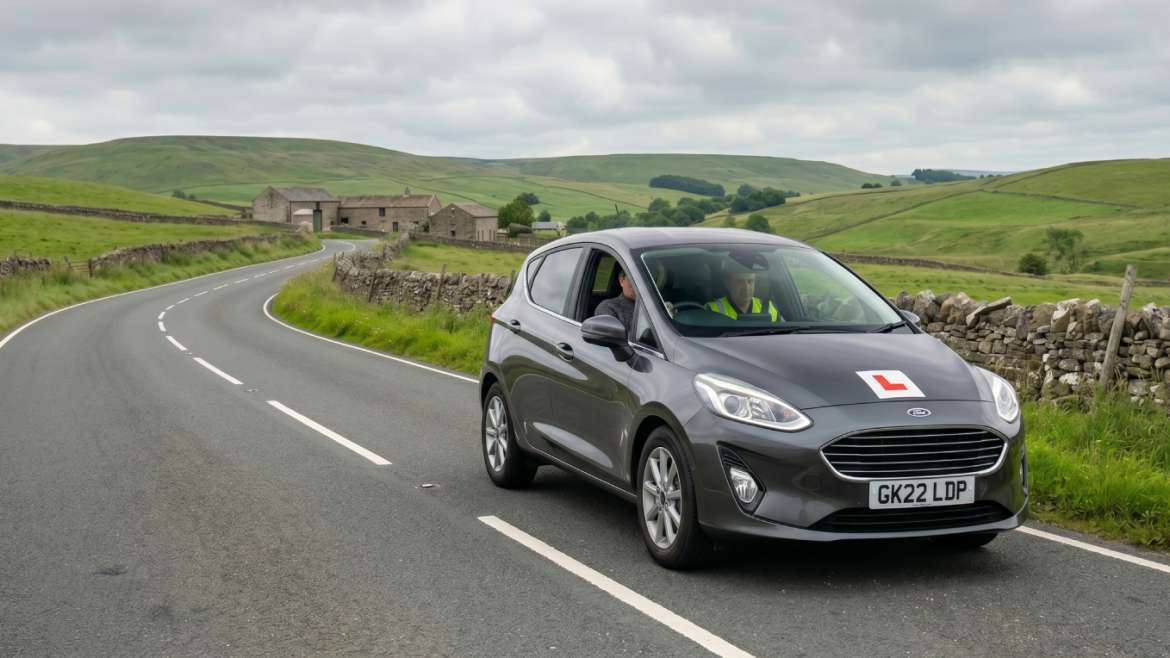
You’ve probably heard it from a friend, a relative, or a bloke in the pub who passed his test twenty years ago and has been holding court on the subject ever since. “They fail you if you stall.” “You’re allowed fifteen minor faults.” “They have a quota — too many people passed this week, so you haven’t got a chance.” The UK practical driving test is one of the most myth-laden experiences a person can go through, and with good reason: it’s high-stakes, nerve-wracking, and almost everyone who’s sat it has an opinion about how it works.
The problem is that bad information doesn’t just cause unnecessary anxiety — it actively makes people worse drivers. When learners train around myths rather than reality, they develop habits that either fail them on the day or, worse, serve them poorly for the rest of their driving lives. This article tackles the most persistent myths head-on, replacing them with the accurate, up-to-date picture of what the DVSA actually expects from you.
Myth 1: “You’re Allowed Up to 15 Minor Faults Before You Fail”
This is probably the most widespread misconception about the practical test, and it contains just enough truth to be genuinely dangerous.
The actual rule is this: you can accumulate up to 15 driver faults (also known as minors) and still pass. But — and this is a significant but — 16 or more driver faults means an automatic fail. So in a narrow, literal sense, yes, 15 is the ceiling. The myth, however, leads people to believe they have a kind of buffer to burn through, as if the test is a points game where you start with credit and spend it down.
The reality is rather different. First, a series of driver faults in the same category can be treated as a serious fault even if each individual instance would only be a minor. If you keep creeping too close to the kerb every time you pull up, an examiner may conclude this represents a persistent and dangerous habit rather than an isolated lapse, and mark it accordingly. Second, and more importantly, no examiner worth their salt is going to pass someone who racks up 14 minors. Statistically, a candidate with that many driver faults is demonstrating an overall standard of driving that most examiners will view as borderline at best. The pass rate for candidates with high numbers of driver faults is considerably lower than for those with fewer.
Think of the 15-fault rule not as a target to approach but as an absolute ceiling that very few passing candidates come anywhere near.
Myth 2: “Stalling Automatically Fails You”
Stalling is the bogeyman of the driving test, and the terror surrounding it is entirely out of proportion to its actual significance.
Stalling does not automatically fail you. It never has. The DVSA’s assessment is based on whether your driving poses a danger to yourself, your examiner, or other road users — and a stall at a quiet junction, handled calmly and correctly, does none of those things. In most cases, a stall will result in a single driver fault, or possibly no fault at all if it happens in a low-risk situation and you manage it well.
What matters is how you respond. If you stall, you should: apply the handbrake, restart the engine calmly, check your mirrors and the surrounding situation, and move off safely when it’s appropriate to do so. That sequence, done smoothly, demonstrates exactly the kind of composed, methodical response that examiners are looking for.
Where stalling becomes more serious is if it happens in a dangerous situation — for instance, pulling out into fast-moving traffic and stalling mid-manoeuvre, leaving your vehicle stranded in a hazardous position. In that scenario it’s not the stall itself that causes the serious fault; it’s the danger created by the circumstances. There’s an important difference.
Many candidates have passed their driving test having stalled at least once. The stall itself is not your enemy. Panicking after the stall is.
Myth 3: “Examiners Have a Pass/Fail Quota”
This one is remarkably persistent, particularly among people who’ve recently failed and are looking for an explanation that doesn’t involve their own driving. The theory goes that examiners are only allowed to pass a certain number of candidates per day, or per week, and that once that quota is filled you’re getting a fail regardless of how well you drive.
There is no such quota. None. It has never existed.
The DVSA is a government agency whose explicit purpose is to promote road safety. Its entire institutional interest lies in only passing candidates who meet the required standard — not in arbitrarily failing good drivers because someone else passed earlier in the day. Examiners are trained assessors whose results are themselves monitored. An examiner whose pass rate diverges significantly from the national average — in either direction — will have their assessments reviewed.
What lends this myth a shred of plausibility is the fact that pass rates do vary between test centres. Some centres in rural areas have historically higher pass rates than busy urban centres. But this reflects the difficulty of the local driving environment, the quality of local instruction, and candidate demographics — not any behind-the-scenes quota management.
If you fail, the reason is in the debrief sheet. Read it carefully, work on those specific areas, and go back prepared.
Myth 4: “You Must Not Exceed the Speed Limit Even Once”
This myth causes learners to drive in an unnaturally timid, dawdling way that is — counterintuitively — more likely to attract driver faults than driving at an appropriate speed.
Briefly exceeding the posted speed limit will not automatically fail you. Sustained, deliberate speeding absolutely will. There’s an important difference between inadvertently creeping a couple of miles per hour over the limit while overtaking, for instance, and barrelling down a 30mph road at 40mph. The former might attract a driver fault depending on the examiner’s view of how significant it was; the latter is a serious or dangerous fault.
What the test is assessing is whether you demonstrate an understanding of speed limits and drive at an appropriate speed for the conditions. “Appropriate” is a nuanced concept. Driving at 28mph in a 30mph zone when conditions are clear and traffic is flowing is entirely appropriate. Driving at 28mph in a 30mph zone in heavy rain, poor visibility, or near a school at kicking-out time may not be. The examiner is assessing your judgement, not just your speedometer reading.
The flip side of this myth is equally important: driving unnecessarily slowly is also a fault. Travelling at 20mph on a clear, dry, 40mph road — purely out of test-day nerves — can result in driver faults for inappropriate speed or undue hesitancy. Examiners want to see you driving confidently and at a reasonable pace.
Myth 5: “The Independent Driving Section Is a Minor Part of the Test”
(Previously, this myth centred on the idea that the independent section was a brief, separate add-on. The November 2025 DVSA reforms make it considerably more significant — and the myth more misleading — than ever.)
Since the DVSA introduced its updated test format in November 2025, the independent driving section has been extended significantly. It has doubled in duration — from 10 minutes to 20 minutes — meaning roughly half of your entire practical test now involves driving without step-by-step guidance from the examiner. If you’ve been told by a friend or relative that the independent bit is a small add-on at the end, they are describing a test that no longer exists. Drivechilterns
Around 80% of tests now use a satnav for the independent driving section, making familiarity with following satnav directions in real traffic a genuine practical requirement rather than a nice-to-have. The remaining tests use road signs. Either way, the aim is to reflect how people actually drive in real life — which is to say, mostly without someone sitting next to them issuing instructions at every junction. Pass N GoDrivechilterns
What hasn’t changed is the underlying assessment principle: the independent driving section is not a separate test with different rules. The same standards apply throughout. Examiners assess sustained decision-making, positioning, and hazard awareness — all without step-by-step instruction. A driver fault recorded during the independent section counts identically to one recorded during any other part of the test. Pass N Go
It’s also worth reiterating a point that causes unnecessary anxiety: taking a wrong turn is not a fault. Missing a turn is not assessed negatively — unsafe reactions to missing a turn are. If you overshoot a junction or misread a satnav prompt, simply continue safely and the examiner will reorient you. Braking sharply, swerving back, or making a rushed and dangerous correction to compensate for a navigational slip — those are what attract marks. Pass N Go
The number of routine pull-up-and-move-off exercises has also been reduced from four to three, and emergency stops now feature in only around one in seven tests rather than one in three. Taken together, these changes mean the 2026 test spends considerably more time assessing how you handle real, flowing, independent driving on busier roads — and considerably less time on choreographed set pieces. Candidates who train exclusively around the latter and neglect the former are preparing for an outdated version of the test. Drivechilterns
The practical implication for learners is clear: independent driving should no longer be treated as a brief section to survive at the end of a lesson. It should be a central part of how you practise from early in your training — following satnav directions, making your own decisions, and building the sustained situational awareness that half a test’s worth of unguided driving now demands.
Myth 6: “The Examiner Is Trying to Trip You Up”
A persistent image of the examiner as an adversary — arms folded, pen poised, looking for any excuse to write something down — causes enormous anxiety and leads candidates to second-guess perfectly reasonable decisions.
Driving examiners are not adversaries. They are trained assessors whose job is to determine, as accurately as possible, whether a candidate’s driving meets a defined standard of safety. They have no personal stake in whether you pass or fail. Many examiners genuinely find failing candidates unpleasant, particularly nervous first-timers.
The DVSA trains examiners to present a neutral, consistent demeanour specifically so that their reactions don’t influence a candidate’s driving. If your examiner writes something down, it doesn’t necessarily mean you’ve made a fault — they also make notes for administrative reasons. If they don’t react warmly to something you do, it doesn’t mean you did it wrong. The poker face is part of the job.
What examiners are looking for is positive evidence that you can drive safely and independently. They’re not sitting there waiting for you to slip up; they’re hoping to see the kind of driving that lets them tick the boxes and hand over a pass certificate. The vast majority of examiners would far rather pass a candidate than fail one.
Myth 7: “You Can’t Fail for Not Checking Mirrors Enough”
Some candidates, particularly those who’ve been told by well-meaning friends to “just look at the mirrors a bit now and then,” believe that mirror checks are a formality that examiners barely monitor.
Mirror use is one of the most heavily weighted aspects of the practical test. Examiners are specifically trained to observe whether candidates check their mirrors at the appropriate times: before signalling, before changing speed, before changing direction, before opening the car door, and as a general habit during normal driving. The MSM (Mirror-Signal-Manoeuvre) routine isn’t a box-ticking exercise; it’s the structural backbone of safe driving.
Failing to check mirrors at critical moments — particularly before pulling out, turning, or changing lanes — can result in serious faults because it represents a genuine safety risk. An examiner cannot know whether you’ve checked your mirrors unless your head actually moves. Subtle glances are insufficient; the movement needs to be deliberate and visible.
What trips many candidates up is the difference between glancing at a mirror and genuinely using it. A useful mirror check involves not just looking but adjusting your behaviour in response to what you see. If there’s a cyclist in your left mirror as you’re about to turn left, you need to wait. Simply looking and turning regardless is not a mirror check; it’s a formality, and an experienced examiner will notice the difference.
Myth 8: “Automatic Cars Are Cheating — and the Licence Is Lesser”
With automatic vehicles becoming increasingly common on UK roads, and a meaningful number of candidates now choosing to learn in automatics, this myth has taken on new relevance.
It’s true that passing in an automatic vehicle results in an automatic-only licence, meaning you’d need a further test to drive a manual. That’s a practical limitation worth knowing about. But the characterisation of automatic test passes as somehow inferior, easier, or less valid is simply wrong.
The practical driving test in an automatic vehicle assesses exactly the same skills: observation, hazard perception, use of speed, positioning, signalling, and independent driving. The only element removed is gear-changing, which — while a genuine skill — is a relatively small part of the overall assessment compared to judgement, observation, and situational awareness. Candidates who pass in automatics are assessed to the same standard in all other respects.
Given that EVs are automatic by design, and that the UK’s vehicle fleet is moving steadily in that direction, this debate will only become less relevant over time. Many driving instructors now actively recommend automatics to candidates who’ve struggled with the coordination required by a manual gearbox, allowing them to focus on the observational and decision-making skills that matter most for lifelong safe driving.
Myth 9: “You Have to Do Every Manoeuvre Perfectly”
The reverse bay park. The parallel park. The forward bay park. The pull-up-on-the-right manoeuvre. These set pieces of the practical test inspire a level of ritualistic preparation — and post-failure blame — that is somewhat out of proportion to their actual complexity.
Manoeuvres do not need to be performed perfectly. They need to be performed safely and under control. The DVSA’s own guidance is clear that candidates are expected to carry out the manoeuvre at a safe speed, with good observation, making effective use of the reference points they’ve been taught, and without causing danger to other road users. A manoeuvre that takes a couple of extra moves to complete, or that ends up not quite as straight as ideal, is not automatically a fault — provided it was done safely and without causing inconvenience to anyone.
What does cause faults during manoeuvres is poor observation (not checking blind spots, not responding to approaching traffic), moving at an unsafe speed, mounting kerbs, or positioning so wide or so close that other vehicles are obstructed or endangered.
The irony is that candidates who fixate on perfecting the geometric precision of their reverse bay park sometimes forget to observe properly during the manoeuvre — which is far more likely to generate a fault than a slightly wonky finish.
Myth 10: “Once You Pass, You’re a Good Driver”
This is perhaps the most insidious myth of all, and the one with the most serious long-term consequences.
Passing the UK practical driving test means you have demonstrated the minimum standard required to drive unsupervised on public roads. It does not mean you are a skilled, experienced, or safe driver in any broader sense. The test is a threshold — a gateway — not a graduation.
The statistics on newly-qualified drivers are sobering. Young drivers between 17 and 24 are involved in a disproportionate number of serious accidents in the UK, and the elevated risk is highest in the first six months after passing. This is not because the test fails to assess the right things; it’s because real driving skill — genuine hazard anticipation, awareness of your own cognitive load, the instinctive responses built through experience — takes years to develop, not the months of a typical learning period.
This is precisely why programmes like Pass Plus exist, why the introduction of the hazard perception test was such an important reform, and why advanced driving organisations such as the Institute of Advanced Motorists continue to offer post-test development. Passing the test is the beginning of learning to drive, not the end.
The best thing a newly-qualified driver can do is maintain the habits instilled during learning — consistent mirror checks, appropriate speed, smooth planning ahead — while understanding that they are still accumulating the experience that turns competence into genuine skill.
A Note on Where These Myths Come From
It’s worth reflecting briefly on why driving test myths are so persistent. A few factors stand out.
The test is emotionally charged. People remember their experience vividly, and they’re prone to attributing a fail to external causes — the examiner, the quota, bad luck — rather than to specific gaps in their driving. Those attributions get retold as fact.
The rules change. The practical test has been revised meaningfully several times over the decades, and people who passed in the eighties or nineties are working from an outdated mental model. The independent driving section, the updated manoeuvres, the current fault-marking criteria — none of these existed in the form a veteran driver might remember.
Confirmation bias is powerful. If you believe there’s a quota and you fail after several friends passed recently, the myth feels confirmed. The possibility that you simply didn’t meet the standard on that particular day is less satisfying and therefore less memorable.
The solution is straightforward: get your information from the DVSA itself, from current editions of The Highway Code, and from a qualified ADI (Approved Driving Instructor). Anyone who passed their test more than a few years ago — however confidently they hold forth — is an unreliable source on the specifics of how today’s test works.
What the Test Is Actually Looking For
Strip away all the myths and the practical driving test is assessing one thing: whether you can drive safely and independently in a range of real-world conditions. The examiners want to see that you:
- Observe consistently and respond appropriately to what you see
- Manage your speed sensibly for the conditions
- Plan ahead and make decisions in good time rather than reacting at the last moment
- Position your vehicle correctly and signal your intentions clearly
- Handle the vehicle smoothly and with control
- Drive with confidence rather than timidity
None of that is secret, esoteric, or unfair. The standard is available publicly, the marking criteria are published, and a good ADI will prepare you thoroughly for exactly what’s expected. The test is hard because driving safely is genuinely difficult — but it is not mysterious, and it is not rigged.
Prepare properly, trust your training, and drive the way you’ve been taught. That’s the only strategy that actually works.
The UK practical driving test is administered by the DVSA (Driver and Vehicle Standards Agency). Test formats, requirements, and pass criteria are subject to change; always consult the official DVSA website or your ADI for the most current information.

