
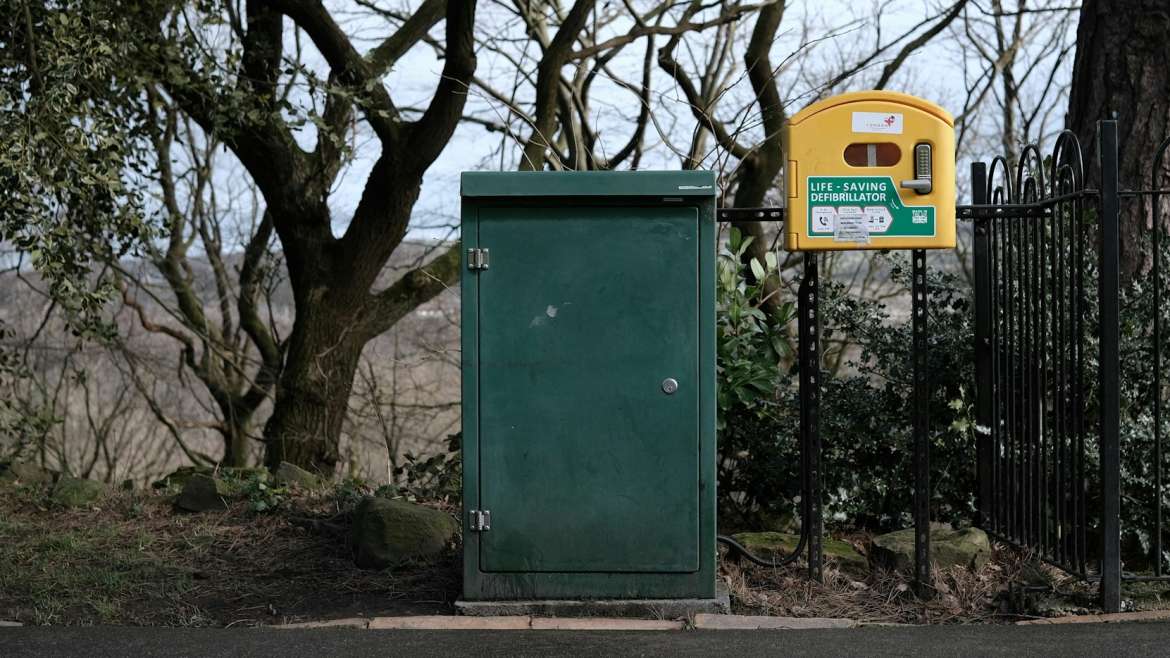
Starting this month, the driving theory test got a lot more serious — and for very good reason. The Driver and Vehicle Standards Agency (DVSA) has introduced 14 new questions focused on first aid, cardiac arrest, and the use of automated external defibrillators (AEDs). If you’re a learner driver preparing for your theory test right now, this update affects you directly. But here’s the thing: what you learn for your test could one day save somebody’s life.
This article covers everything you need to know — the new questions, the key numbers to memorise, how AEDs work, and why your driving instructor might soon be pointing out a little green box on the wall of your local supermarket.
Why Has the DVSA Added First Aid Questions?
Road traffic incidents remain one of the most common situations in which members of the public witness a cardiac arrest or serious medical emergency. Bystander intervention — acting quickly before an ambulance arrives — is the single greatest factor in determining whether someone survives.
According to the British Heart Foundation, around 30,000 out-of-hospital cardiac arrests occur in the UK each year. Survival rates remain stubbornly low, largely because CPR is not started soon enough and AEDs are not used when they’re available. The DVSA’s decision to embed first aid knowledge into the theory test reflects a broader push to ensure that every driver on Britain’s roads has at least a foundational understanding of how to respond in a life-threatening emergency.
It is, frankly, long overdue.
What Are the New Theory Test Questions About?
The 14 new questions span three core areas:
1. Recognising cardiac arrest You’ll need to understand the signs that someone has gone into cardiac arrest — unresponsiveness, absence of normal breathing, and the absence of a pulse. The test may ask you to distinguish between someone who is unconscious but breathing and someone who requires immediate CPR.
2. Performing CPR correctly This is where the specific numbers come in, and they are the ones most learners are searching for. If you remember nothing else from this article, remember these:
- Compression depth: 5–6 centimetres
- Compression rate: 100–120 compressions per minute
- Ratio: 30 chest compressions to 2 rescue breaths
Five to six centimetres sounds deep — and it is. Many people instinctively hold back, worried about hurting the person. But effective CPR requires firm, confident pressure. Blood will not circulate adequately without it. The Resuscitation Council UK is unambiguous on this point: push hard, push fast.
3. Using an AED (Automated External Defibrillator) This is perhaps the most important new area, and it comes with a question that trips many learners up: Do you need medical training to use a defibrillator?
The answer is no. Anyone can use an AED. They are specifically designed for untrained bystanders.
Everything You Need to Know About AEDs
An AED is a portable device that analyses the heart’s rhythm and, if necessary, delivers an electric shock to restore a normal heartbeat. They are found in an ever-growing number of public places — shopping centres, train stations, leisure centres, sports clubs, and increasingly, community noticeboards and village halls.
Here is what the DVSA wants you to know:
You do not need training. The device guides you through every step with clear spoken instructions and visual prompts. It will tell you where to place the pads, when to step back, and when a shock is being delivered.
Switch it on immediately. The moment you open the case or press the power button, the AED begins talking to you. Do not wait. Do not hesitate. Follow the voice.
It will only shock if a shock is needed. AEDs analyse the heart’s rhythm automatically. If the device determines that a shock is not appropriate, it will not deliver one. You cannot accidentally shock someone who does not need it.
Timing is everything. This is the statistic the theory test is built around: using an AED within the first 3–5 minutes of cardiac arrest can increase survival rates to as high as 70%. For every minute that passes without defibrillation, survival odds drop by approximately 10%. After ten minutes without intervention, survival becomes very unlikely. The ambulance service does an extraordinary job, but response times mean that bystander action in those first critical minutes is irreplaceable.
The CPR Numbers: A Revision Summary
Because this is a theory test, the examiners want specific, accurate knowledge. Vague answers will not pass. Here is a clean summary of the figures you need to have at your fingertips:
| What | The Number |
|---|---|
| Compression depth | 5–6 cm |
| Compression rate | 100–120 per minute |
| Compressions before rescue breaths | 30 |
| Rescue breaths given | 2 |
| AED survival window | 3–5 minutes |
| Potential survival rate with early AED | Up to 70% |
If rescue breaths are not possible — perhaps because you are not trained in them, or the situation makes them impractical — hands-only CPR is still enormously valuable. Thirty compressions, repeated continuously, will do far more than doing nothing at all.
A Crucial Point: CPR Will Not Restart the Heart
This is a common misconception worth addressing. CPR does not restart a stopped heart. What it does is buy time — it keeps oxygenated blood moving to the brain and vital organs until a defibrillator is available or paramedics arrive. The AED is what delivers the electrical shock capable of restoring a normal rhythm. CPR and AED use are not alternatives; they work together.
Think of CPR as keeping the engine ticking over, and the AED as the ignition.
How to Prepare for These Questions
The good news is that this material is genuinely learnable, and learning it properly — rather than simply memorising numbers — will serve you far better under exam conditions.
Use the Highway Code and DVSA guidance. The official materials have been updated to reflect the new content. Make sure any revision app or book you are using is the 2026 edition.
Practise mock questions. The new questions will begin appearing in reputable theory test practice platforms. Filter specifically for the hazard perception and safety sections, and look for any new first aid categories.
Understand, don’t just memorise. The questions are designed to test whether you would actually know what to do. Scenario-based questions — “You arrive at the scene of a collision and a person is unresponsive and not breathing normally. What should you do first?” — are more effectively answered if you understand the underlying logic rather than reciting a list.
Consider a basic first aid course. This is not required for the theory test, but it is genuinely worthwhile. Many local organisations offer half-day CPR and AED awareness sessions, some of which are free. Knowing that you could act effectively in an emergency is worth far more than a pass certificate.
A Note for Learner Drivers in Princes Risborough
Here is a practical tip that your driving instructor may already be incorporating into lessons: the next time you are out on a drive around Princes Risborough, take a moment to notice where your nearest public AED is located.
There are defibrillators at a number of locations across the area — community centres, supermarkets, the train station, and local sports facilities. Knowing where they are is not a small thing. In the minutes following a cardiac arrest, the difference between life and death often comes down to whether someone nearby knows where the nearest AED is and has the confidence to use it.
Pointing out an AED on a driving lesson is a brilliant way to make the theory feel genuinely relevant, rather than just another box to tick. Road awareness is not limited to hazard perception clips and stopping distances. It includes being aware of the community around you — and being ready to respond.
What Happens If You Get These Questions Wrong?
The theory test requires a score of at least 43 out of 50 in the multiple-choice section. There is no separate pass mark for the new first aid questions — they are weighted the same as any other question. However, given that 14 new questions have been added covering this topic area, it would be a significant risk to leave this material unstudied.
More to the point: these are questions about real situations that really happen. Getting them wrong on paper is unfortunate. Getting them wrong in the car park of a retail park on a Tuesday afternoon, with someone’s father unconscious on the ground in front of you, is another matter entirely.
The Bigger Picture
The DVSA’s update is part of a wider cultural shift in how the UK thinks about cardiac arrest. The installation of public AEDs has accelerated considerably over the past decade, partly driven by the efforts of charities, partly by the harrowing and high-profile collapses of professional footballers on live television — events that made millions of people suddenly, viscerally aware of how quickly and unexpectedly cardiac arrest can strike.
By embedding first aid knowledge into the driving test, the DVSA is, in effect, saying: every driver is a potential first responder. Every person who passes their theory test this year leaves the test centre knowing a little more about how to help — and that, at scale, saves lives.
If you are preparing for your test right now, study these questions with the same seriousness you give to motorway rules or stopping distances. They matter just as much. And on the day you need them, they will matter a great deal more.
For a more detailed look at first-aid topics relevant to the theory test, see my article on CPR and defibrillator questions.